
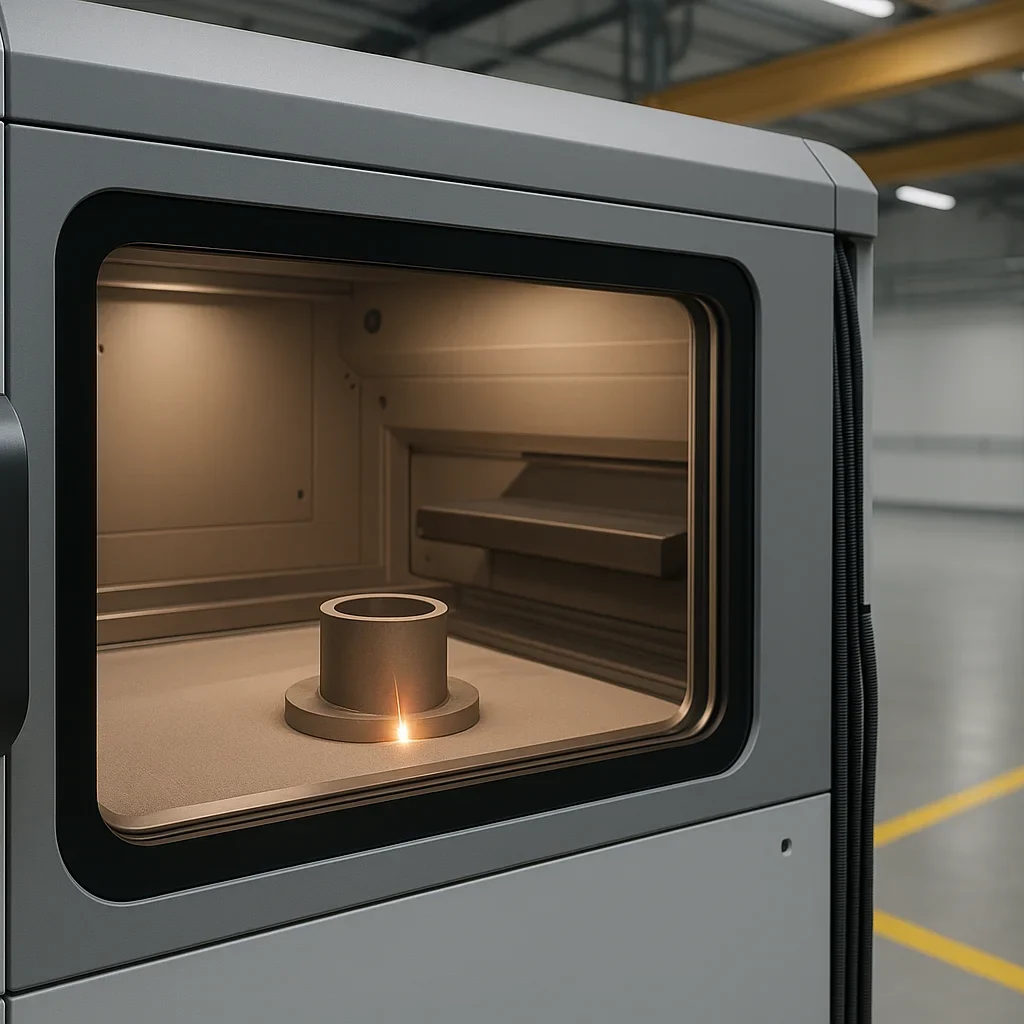
Next-Generation Additive Manufacturing Services
SARITVAT Empowering Innovation with Smarter, Sustainable, and Digitally Connected Additive Manufacturing
Additive manufacturing (AM), often known as 3D printing, is transforming product development with speed, flexibility, and cleaner processes. At SARITVAT, we handle every project with a practical and human-first approach—balancing what’s technically possible with what’s realistic for your timelines and business goals. We collaborate closely with trusted Vendors and understand local compliance requirements so your journey from concept to production stays smooth, transparent, and grounded in real-world needs.
Our solutions bring design, simulation, and production together into one connected digital workflow. By working alongside skilled Manufacturers, we help your team make clear, confident, data-backed decisions. Our advanced 3D printing services deliver lightweight, strong parts quickly—reducing waste and environmental impact. And when speed matters, we often produce through facilities nearby to keep lead times short and communication easy.
We support fast-moving product development with real-time collaboration tools, cloud-based design environments, and scalable production options. Our proactive Support ensures you feel heard and assisted at every step, helping your engineers iterate faster without compromising ethics, quality, or traceability. Whether you need early prototypes or production-ready parts, SARITVAT helps you achieve consistent quality and faster market launch using a digitally smart manufacturing ecosystem.
With a focus on sustainability, digital integration, and new-age materials, we help organizations unlock the full value of additive manufacturing in today’s competitive market. We also partner with reliable Suppliers who follow responsible sourcing standards to ensure your project moves from RFQ to delivery seamlessly and transparently.
Key Advantages of Additive Manufacturing
Faster product development with rapid prototyping—built around clear requirements that any knowledgeable Supplier would expect.
Reduced waste and cleaner manufacturing processes.
Greater design freedom with complex internal channels and lattice structures.
Digital workflows that cut down manual work and reduce errors.
Easy scalability—from a single part to full production runs.
Eco-friendly options using sustainable or recycled materials.
High precision suitable for functional, production-grade components.
End-to-end traceability through CAD/CAM integrations.
Custom parts designed with parametric and generative modeling.
Quick iteration cycles for ongoing improvements.
Industries and Practical Use Cases
Aerospace: Flight-ready, lightweight parts enhanced with topology optimization.
Medical: Biocompatible surgical tools and implants tailored to each patient.
Automotive: Lightweight, durable parts made from sustainable materials.
Consumer Electronics: Custom enclosures ideal for low-volume production.
Energy: High-performance turbine and pump parts made using metal powders.
Robotics: On-demand printed actuator housings and sensor mounts.
Marine: Durable, corrosion-resistant components for underwater use.
Advanced Materials for Additive Production
High-Performance Polymers: PA12, TPU, PEEK for strength and heat resistance.
Metal Powders: Aluminum, Inconel, and tool steels for high-strength metal parts.
Flexible Materials: TPE and other elastomers for wearable or moving components.
Bio-Materials: Eco-friendly PLA blends and biodegradable filaments.
Ceramics: Zirconia and silicon carbide for extreme environments.
Conductive Polymers: Ideal for sensors and electronics integration.
Recycled Composites: Sustainable options supporting circular manufacturing.
Cost Estimation and Pricing Strategy
At SARITVAT, pricing is tailored to your design complexity, material choices, and production volume. By using digital workflows and on-demand manufacturing, we help cut down inventory and eliminate expensive tooling—giving you the cost clarity that practical Suppliers appreciate when time and budget matter.
Whether you need prototypes, bridge manufacturing, or full-scale production, our flexible pricing models adapt to your needs. Smart slicing tools and simulation-backed pre-build checks ensure accurate material usage and predictable pricing, helping you make well-informed decisions without surprises.
We also prioritize sustainability—choosing recycled or bio-based materials can reduce both cost and environmental impact. Every quote includes a transparent pricing breakdown to help procurement, engineering, and operations teams stay aligned.
Complementary and Alternative Methods
Injection Molding: Best for mass production after design validation.
Precision Casting: Ideal for complex or legacy replacement parts.
CNC Machining: Great for tight tolerances and finishing printed parts.
Vacuum Casting: Suitable for short-run elastomeric prototypes.
3D Scanning + Reverse Engineering: Perfect for rebuilding or upgrading legacy designs.
Blow Molding: For hollow plastic components like bottles and containers.
Tool-Free Forming: Speeds up the creation of soft tooling for hybrid processes.
FAQs
Q: What is additive
manufacturing?
A: Additive manufacturing,
often called 3D printing, builds parts layer by
layer from a digital model. It offers excellent
design freedom, reduces waste, and keeps the
process transparent and user-friendly.
Q: How is metal printing
different from traditional metal
fabrication?
A: Metal printing creates parts
layer by layer using metal powders or deposition
methods, making complex shapes possible without
molds. It also simplifies quality checks and
reduces material use compared to traditional
cutting or casting.
Q: What materials can be used in
SARITVAT’s additive manufacturing processes?
A: We work with polymers,
composites, ceramics, and metal powders like
titanium, aluminum, and stainless steel.
Materials are chosen carefully in collaboration
with qualified Supplier
networks based on performance and regulatory
needs.
Q: How does direct digital
manufacturing improve production efficiency?
A: Direct digital manufacturing
removes the need for tooling and extra steps,
letting you produce parts when you need them.
This brings faster turnaround, clearer decision
gates, and better oversight on quality and cost.
Q: Which industries benefit from
additive manufacturing prototyping?
A: Aerospace, automotive,
medical, consumer electronics, defense, and more
rely on SARITVAT’s prototyping services for fast
design iterations and real-world testing—while
keeping ethics and reliability at the core.
Q: What is additive engineering,
and how does it help product design?
A: Additive engineering focuses
on optimizing designs for 3D printing—improving
strength, reducing weight, and combining
multiple parts into one. This makes validation
easier and speeds up development cycles.
Q: Can SARITVAT handle
large-scale production with additive
manufacturing?
A: Absolutely. We use advanced
technologies and scalable direct digital
manufacturing to support both small and large
production batches, working with dependable
Suppliers to maintain
consistency.
Q: How does SARITVAT ensure
quality in metal deposition processes?
A: Every metal deposition
project follows strict quality checks, including
inspecting each layer for accuracy and material
integrity. We maintain open communication and
clear documentation throughout.
Q: What are the cost benefits of
using additive manufacturing?
A: It minimizes waste, removes
tooling costs, speeds up development, and
shortens time-to-market—making it cost-effective
for both prototypes and end-use parts. It also
gives procurement teams full transparency.
Q: Why choose SARITVAT for
additive manufacturing services?
A: We combine experience in
additive engineering, metal printing, and
digital manufacturing to deliver tailored,
high-quality components. With strong
partnerships across Vendors and
Suppliers, we keep your project
predictable, ethical, and efficient.
Q: In which countries does
SARITVAT offer its Additive Manufacturing
services?
A:
Asia: India, Japan, South Korea, Indonesia,
Vietnam, Thailand, Malaysia, Taiwan, Singapore,
Philippines, Bangladesh
Europe: Germany, United Kingdom, France, Italy,
Netherlands, Spain, Poland, Belgium,
Switzerland, Sweden, Austria, Czech Republic
South America: Brazil, Argentina, Chile,
Colombia, Peru
Middle East: Saudi Arabia, United Arab Emirates,
Turkey, Israel, Qatar, Kuwait
Africa: South Africa, Nigeria, Egypt, Morocco,
Kenya, Ethiopia
Oceania: Australia, New Zealand
North America: United States, Mexico, Canada
A: By Sea: Asia: 15–20 days, Europe: 25–35 days, North America: 30–40 days, South America: 35–45 days, Middle East: 14–18 days, Africa: 20–28 days, Oceania: 22–30 days
By Air: Asia: 1–3 days, Europe: 3–5 days, North America: 4–6 days, South America: 5–7 days, Middle East: 1–2 days, Africa: 3–5 days, Oceania: 4–6 days