
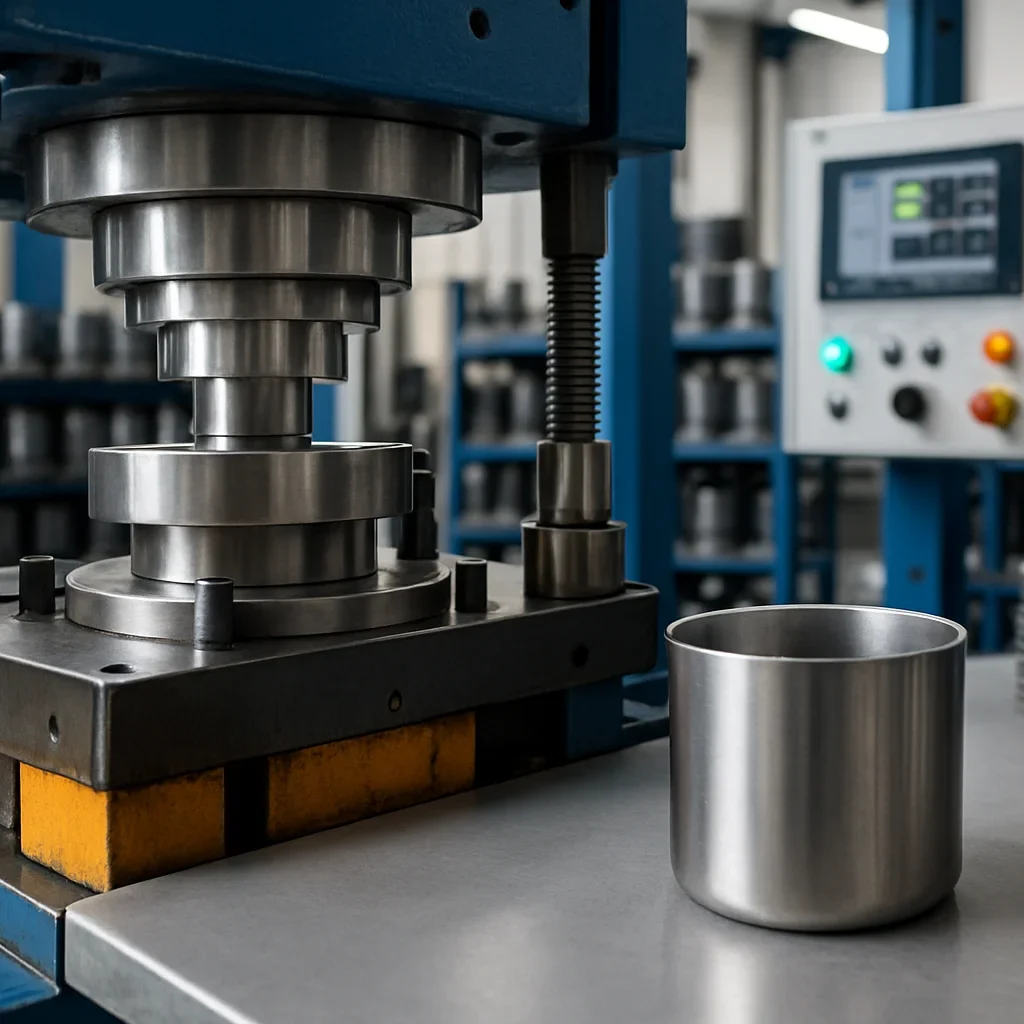
Deep Draw Tooling
SARITVAT – Simplifying Deep Draw Tooling for Precision Sheet Metal Parts
Deep draw tooling is a specialized manufacturing method where flat sheet metal blanks are transformed into precise, three-dimensional components—often cylindrical or box-shaped. At SARITVAT, we combine advanced tooling techniques, high-performance hydraulic presses, and years of hands-on experience to make this process reliable and hassle-free. We work closely with trusted Vendors, experienced Suppliers, and dependable Manufacturers, all sharing our commitment to quality and ethical practices. Our Support systems, along with local and nearby resources, make sure every project runs smoothly and meets your expectations.
Our tooling solutions help achieve deep drawn components with tight tolerances and minimal defects. By using custom punches, dies, blank holders, and ejectors, SARITVAT produces high-strength, seamless parts consistently. This success comes from coordinated work with Suppliers, carefully chosen Vendors, and proven Manufacturers who value ethical production. Strong Support from local engineering teams and nearby technical experts ensures every stage—from progressive dies to flow forming—is executed with precision.
From initial tooling design to final finishing, we focus on wrinkle-free surfaces, material efficiency, and smooth transitions. Our supplier and Vendor collaborations, paired with skilled Manufacturers, create a reliable Support network that’s both local and nearby. Whether for high-volume metal stamping or small-batch specialty parts, we work with every Supplier and Vendor to deliver quality deep draw tooling solutions that respect timelines and ethical manufacturing.
Benefits of Technology
SARITVAT’s deep draw tooling is perfect for high-volume, repeatable metalworking projects, with nearby Vendors and local Suppliers providing transparent supply chains and instant Support. Components gain superior strength and dimensional stability, produced in partnership with ethical Manufacturers and trusted Suppliers. The method supports a variety of metals through efficient tooling setups, guided by every Supplier and experienced Vendor.
Seamless components remove the need for welding, boosting corrosion resistance and delivering added value for Manufacturers and Vendors in regulated industries. Flow forming enhances draw ratios and improves grain structure, guided by feedback from local Suppliers and dependable Vendors. This technology works across multiple industries, using hydraulic presses for smooth forming cycles, supported by Manufacturers and supplier-managed maintenance schedules.
Progressive and redraw tooling designs are tailored for part consistency, incorporating insights from nearby Support Vendors and local technical specialists. Complex parts can often be formed in one pass using compound deep drawing dies co-engineered with skilled Suppliers and Manufacturers. Ethical Vendor–Supplier partnerships improve compatibility with metal stamping operations, while waste reduction and smooth workflows are supported by the same reliable nearby Support networks.
Industrial Application and Use Cases
Automotive Sector: Fuel tanks, clutch housings, and structural panels produced using deep drawn parts on high-tonnage hydraulic presses, with Support from nearby Vendors and automotive-grade Suppliers.
Consumer Appliances: Stainless steel sinks and cookware formed with multi-stage deep draw tooling and flow forming, in collaboration with local Manufacturers and feedback from Suppliers.
Aerospace & Defense: Lightweight housings and enclosures crafted with progressive deep draw tooling and metal stamping, supported by trusted Vendors and defense-certified Manufacturers.
Industrial Equipment: Custom covers and cylinders made from hardened sheet metal with durable tooling standards, maintained through Support from nearby Vendors and reliable Suppliers.
Medical & Electronics: Precision caps, containers, and shells produced with compound deep drawing dies and high-grade fabrication equipment, supported by local Suppliers and specialist Manufacturers.
Material Used in Technology
Stainless Steel: Perfect for food-grade and corrosion-resistant parts, sourced from reputable Suppliers and experienced Vendors.
Aluminum: Lightweight and easy to form, optimized for flow forming with input from Manufacturers and local Suppliers.
Cold Rolled Steel: Widely used for structural parts, supplied by reliable Vendors offering strong Support in the region.
Brass & Copper: Ideal for high-end or conductive parts, relying on trusted Suppliers and experienced Vendors.
Tool Steels: Hardened D2 or H13 steels for durable tooling, consistently provided by nearby Suppliers and global Vendors.
How Costing Works
Project cost depends on part complexity, draw depth, materials, and production volume. Multi-stage setups like progressive or compound dies may raise upfront costs but reduce unit costs over time, with Suppliers and Vendors coordinating efficient material and tooling Support. Hydraulic presses and flow forming improve efficiency, backed by local Manufacturers and nearby supplier-vendor teams.
We account for cycle time, material yield, and secondary operations, with ethical input from Manufacturers, Suppliers, and Vendors. Vendor quotes and manufacturer timelines ensure fair pricing, supported by local Support for domestic and international projects.
Alternative Technical Suggestion
Progressive Die Forming: Streamlines multiple steps in one die set, improved by Supplier designs and Vendor materials.
Compound Deep Drawing Die: Draws and pierces in one step, designed with Manufacturers and backed by nearby Vendors.
Flow Forming: Enhances tensile strength and reduces wall thickness, guided by Suppliers and local Support.
Redraw Tooling Design: Refines pre-drawn cups, tested with Vendors and validated by Manufacturers.
Metal Stamping Add-ons: Adds flanges, ribs, and holes during forming, integrating Supplier and Vendor feedback.
Hydraulic Press Options: Manual or servo-driven presses for different production scales, supported by nearby Vendors and skilled Suppliers.
FAQs
Q: What is deep draw
tooling?
A: It’s a process that transforms flat sheet
metal into hollow parts using punches and dies,
with Support from
Suppliers, trusted
Vendors, and skilled
Manufacturers.
Q: How is it different from other forming
methods?
A: It forms seamless shapes via progressive or
compound dies, often with flow forming,
requiring teamwork among
Suppliers,
Vendors, and
Manufacturers.
Q: Which materials are commonly
used?
A: Stainless steel, aluminum, copper, and brass,
shaped with tools from ethical
Suppliers and experienced
Vendors.
Q: What are the main
benefits?
A: High strength, no joints, and smooth
finishes, backed by reliable
Support from
local
Suppliers and
Vendors.
Q: What role do hydraulic presses
play?
A: They provide controlled force and repeatable
accuracy, maintained by nearby
Vendors and
Suppliers.
Q: How is sheet thickness
controlled?
A: Through precision tooling and process checks
guided by Vendors and
Manufacturers with
Support from
Suppliers.
Q: How are progressive dies
used?
A: They combine multiple forming steps,
developed with local
Suppliers and
Vendors.
Q: Which industries benefit
most?
A: Automotive, aerospace, and industrial
sectors, all supported by ethical
Manufacturers and
Vendors.
Q: What are the limitations?
A: Tooling costs and material constraints,
managed with Supplier guidance
and Vendor trials.
Q: Why choose SARITVAT?
A: We deliver ethical, precision solutions
backed by Suppliers,
Vendors, and
Manufacturers with strong
local and
nearby
Support.
A: By Sea: Asia: 15–20 days, Europe: 25–35 days, North America: 30–40 days, South America: 35–45 days, Middle East: 14–18 days, Africa: 20–28 days, Oceania: 22–30 days
By Air: Asia: 1–3 days, Europe: 3–5 days, North America: 4–6 days, South America: 5–7 days, Middle East: 1–2 days, Africa: 3–5 days, Oceania: 4–6 days