
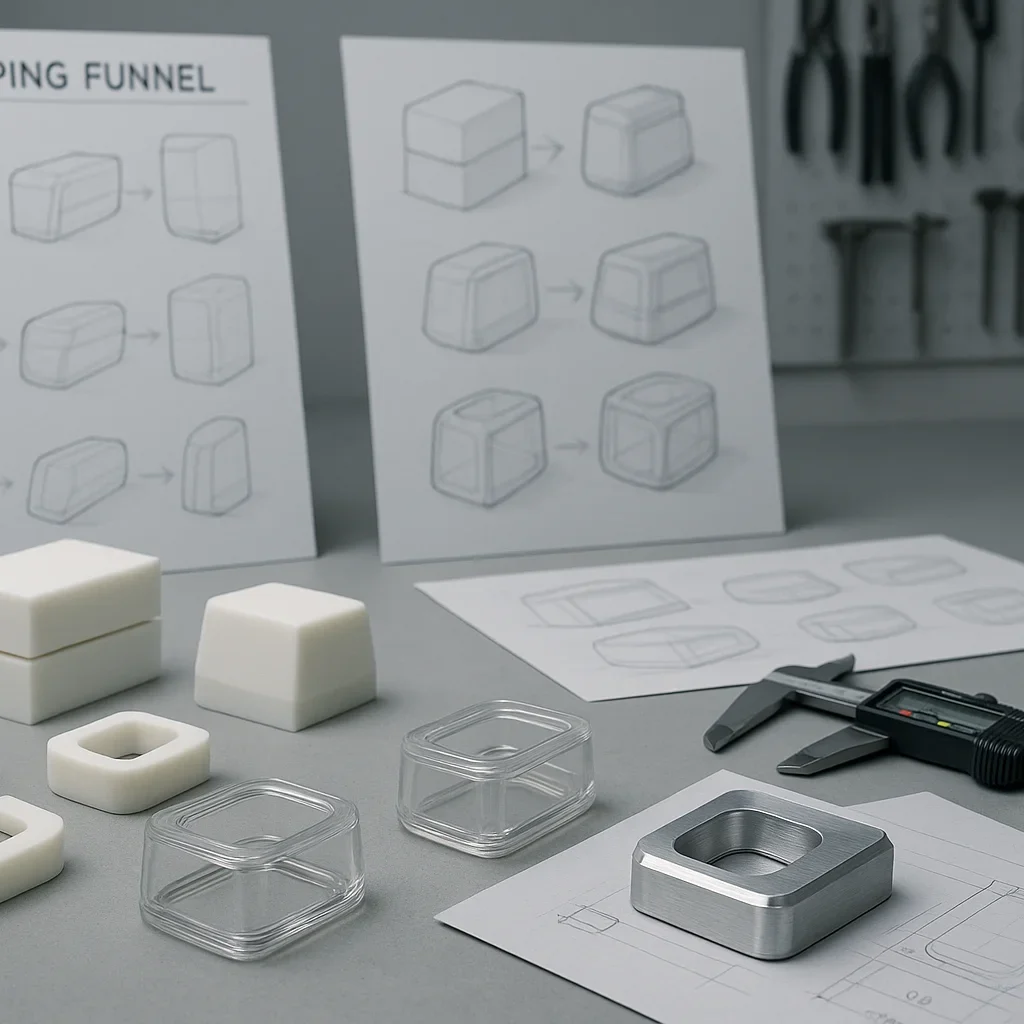
Rapid Prototyping
SARITVAT – Your Partner in Rapid Prototyping and On-Demand Manufacturing
Rapid prototyping is a game-changer, helping companies – from local startups to innovative regional players – turn ideas into real, tangible models quickly and accurately. At SARITVAT, we work hand-in-hand with trusted Vendors and reliable Suppliers to provide a full range of rapid prototyping services for industries like consumer electronics, medical devices, and automotive innovation. Our Manufacturers and Support teams make sure every prototype is delivered on time and ethically produced.
We use a mix of technologies like SLA printing, SLS printing, CNC machining, and CNC routing to deliver fast, flexible, and functional prototypes. By collaborating closely with nearby Suppliers and regional Vendors, we integrate expertise in CNC workflows and machining processes, producing high-quality parts with shorter lead times and lower costs – all backed by our human-focused Support teams and responsible Manufacturers.
From laser cutting for precise sheet fabrication to injection molding for pilot production, SARITVAT is your trusted local partner. We also work with liquid silicone for soft and transparent components, and offer various plastic molding processes for scalable prototyping. Our contract manufacturing team supports the full lifecycle – from early-stage prototype development with local Suppliers to scaling production with ethical Manufacturers and dedicated Vendors.
Benefits of Technology
Quick and cost-effective production of complex designs, thanks to Vendors and Manufacturers who provide local insight and Support to simplify decision-making.
CNC routing and machining ensure precise details, supported by ethical Suppliers and reliable Vendors, with our technical Support guiding every step.
Test multiple design iterations easily with SLA and SLS printing, coordinated by nearby Suppliers and trusted Manufacturers for consistent results.
Create functional prototype units with industrial-grade materials sourced from certified Vendors and supported by local Suppliers and knowledgeable Manufacturers.
Smoothly transition from prototyping to contract manufacturing with help from nearby Vendors, local Supplier networks, and dependable Manufacturers for sustainable scaling.
Produce both hard machined parts and soft liquid silicone models efficiently, supported by ethical Vendors, proactive Suppliers, and collaborative local Manufacturers.
Speed up production with laser cutting and direct-to-fabrication methods, coordinated by nearby Suppliers, responsible Vendors, and local Support engineers.
Perfect for pre-production validation with real-world materials and tolerances, provided by trusted Vendors, ethical Manufacturers, and hands-on local Support.
Industrial Application and Use Cases
Automotive: Gear housings, dashboard panels, and functional lighting prototypes, developed with Vendors, local Suppliers, and automotive Manufacturers offering reliable Support.
Medical Devices: Custom casings using liquid silicone and biocompatible SLA printing, made by Suppliers and Vendors with precision, safety, and ethical Manufacturer oversight.
Aerospace: Lightweight plastic and complex CNC-routed parts provided by nearby Vendors, with full Supplier and Manufacturer Support.
Consumer Electronics: Enclosures, wearables, and small machined parts created by Vendors, handled by regional Suppliers, and validated by local Manufacturers.
Product Design: Concept validation with rapid prototyping, CNC routing, and laser cutting, supported by nearby Manufacturers, local Suppliers, and expert Vendors.
Industrial Tools: Ergonomic handles and fixtures produced with SLS printing and CNC machining, supported by Vendors, Suppliers, and local tooling Manufacturers.
Robotics: Structural frames and brackets fabricated via CNC routing, coordinated with local Manufacturers, ethical Vendors, and dedicated Suppliers.
Startups: Turn your MVP ideas into reality with contract manufacturing Support, ethical guidance, and collaboration from local Vendors, regional Suppliers, and nearby Manufacturers.
Material Used in Technology
ABS and PLA: Common thermoplastics for prototyping, sourced sustainably by local Suppliers and Vendors, supported by nearby Manufacturers.
Resins: Perfect for SLA printing and high-detail prototypes, provided by trusted Vendors and implemented ethically by local Manufacturers with Support.
Nylon and PA12: Durable materials for SLS printing, procured by reliable Suppliers and Vendors to ensure consistent quality for Manufacturers.
Silicone Rubber: Used for flexible parts in liquid silicone molding, sourced through Vendors and handled precisely by Suppliers and Manufacturers.
Acrylic and Polycarbonate: Laser-cut for transparency and strength, provided by ethical Vendors, informed Suppliers, and engineered with local Manufacturer Support.
Aluminum and Steel: Precision machined via CNC, using metal blanks from regional Suppliers and local Vendors, supported by advanced Manufacturers.
Epoxy Composites: Functional prototypes requiring thermal resistance and strength, sourced from supportive Suppliers, processed by Vendors, and guided by Manufacturers with local Support networks.
How Costing Works
Our rapid prototyping pricing is transparent and value-focused. Factors include complexity, material type, Vendor coordination, Supplier sourcing, and Manufacturer precision – all with clear Support communication.
SLA or SLS prototypes are cost-effective for design evaluation, with nearby Suppliers and local Vendors reducing risk and providing reliable Support throughout.
CNC routing and machining costs are slightly higher due to tooling and material, but minimized with guidance from responsible Vendors, nearby Suppliers, and Manufacturers.
Low-run plastic molding or injection molding benefits from economies of scale. Vendors, Suppliers, and Manufacturers collaborate to provide optimized batch pricing with Support at every step.
From laser-cut panels to complete machined parts, transparent pricing ensures value, backed by ethical Vendors, regional Suppliers, and local Manufacturer Support.
Alternative Technical Suggestion
FDM 3D Printing: Entry-level prototyping for form and fit, supported by nearby Suppliers and small-scale Vendors, with scalable options from regional Manufacturers.
Urethane Casting: Ideal for soft parts before silicone molds, supported by Vendors, ethical Suppliers, and nearby Manufacturers for early-stage tooling.
Sheet Metal Fabrication: Alternative to plastic molding for rigid enclosures, coordinated by Vendors and Suppliers with decision-making Support from Manufacturers.
Hybrid Prototyping: Combines CNC routing and SLS printing for structural and aesthetic functionality, executed by ethical Vendors, trusted Suppliers, and local Manufacturers.
RTV Molding: Low-run molds before injection molding, guided by nearby Suppliers, Vendors, and supported by Manufacturers for fast turnaround.
Selective Laser Melting: Metal parts alternative to CNC machining, led by regional Vendors and Suppliers, with support from advanced Manufacturers.
Stereolithography: High-precision prototypes, made possible by nearby Vendors, Suppliers, and expert local Manufacturers.
FAQs
Q: What is rapid
prototyping?
A: Rapid prototyping is a set of techniques to
quickly create a scale model of a part using 3D
data. This includes SLA printing, CNC machining,
and CNC routing, coordinated by local Vendors,
Suppliers, and Manufacturers.
Q: Why use rapid prototyping over
traditional methods?
A: It’s faster, flexible, cost-effective, and
allows testing multiple iterations quickly.
Nearby Vendors, ethical Suppliers, and
supportive Manufacturers make it collaborative
and efficient.
Q: How does CNC routing
help?
A: CNC routing produces precise 2.5D and 3D
components. Local Vendors and Suppliers ensure
timely delivery, while nearby Manufacturers
maintain quality and consistency.
Q: Difference between SLA and SLS
printing?
A: SLA gives high-detail resin parts for form
validation. SLS provides durable powder-based
prototypes. Vendors and Suppliers coordinate
with Manufacturers to choose the best option.
Q: Can I get end-use parts through rapid
prototyping?
A: Yes. Nearby Vendors, reliable Suppliers, and
advanced Manufacturers can produce small-batch
or MVP-ready parts, with full lifecycle Support.
Q: Typical lead times for machined
parts?
A: With streamlined Vendor and Supplier
workflows near local Manufacturers, lead times
can be 2–5 business days, supported by agile
operations and customer-focused Support.
Q: Is liquid silicone molding suitable
for medical prototypes?
A: Absolutely. Biocompatible materials sourced
by Vendors, and ethical Manufacturers deliver
compliant results with ongoing Support.
Q: How does contract manufacturing help
scale from prototype to
production?
A: Nearby Vendors and Suppliers help transition
parts to Manufacturers for mass production, with
SARITVAT Support ensuring quality and
coordination.
Q: Why use laser cutting?
A: Laser cutting shapes flat materials quickly.
Vendors and Suppliers provide input, while
Manufacturers and Support teams ensure
precision.
Q: How to choose between plastic molding
and CNC machining?
A: For higher volumes or hollow parts, plastic
molding is best. For tighter tolerances or
metals, CNC machining is ideal. SARITVAT guides
you through this decision ethically.
A: By Sea: Asia: 15–20 days, Europe: 25–35 days, North America: 30–40 days, South America: 35–45 days, Middle East: 14–18 days, Africa: 20–28 days, Oceania: 22–30 days
By Air: Asia: 1–3 days, Europe: 3–5 days, North America: 4–6 days, South America: 5–7 days, Middle East: 1–2 days, Africa: 3–5 days, Oceania: 4–6 days